
Square-paper (grid) area is a quick graphical check when you already have a scale-drawn sketch. It does not replace chain survey or coordinate area for final records, but it is useful for office verification and teaching.
1. What you need
- A sketch of the plot drawn to a known scale (e.g. 1:1000).
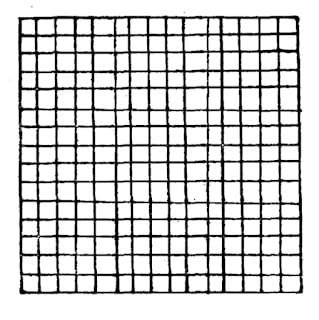
- Transparent or overlay square paper (graph paper). Example grids often use 5 mm squares.
- The ground area represented by one small square at that scale (see below).
2. Area of one small square
If the map scale is 1 : S (one unit on paper = S units on ground), and each grid square has side d on paper:
Ground side of one square = d × S.
Ground area of one square = (ground side)².
Example (common teaching case): scale 1:1000, square side 5 mm = 0.005 m on paper.
- Ground side = 0.005 × 1000 = 5 m.
- Area of one square = 25 m² = 0.25 are (since 1 are = 100 m²).
Always recompute this for your scale and grid size — do not memorise one number for all sketches.
3. Method
- Place the square paper over the scale sketch so the plot sits fully on the grid.
- Count whole squares completely inside the boundary.
- Estimate part squares along the boundary: group fragments that together make whole squares (or count halves/quarters carefully).
- Total squares ≈ whole + equivalent whole from parts.
- Area = (total squares) × (area per square at that scale).
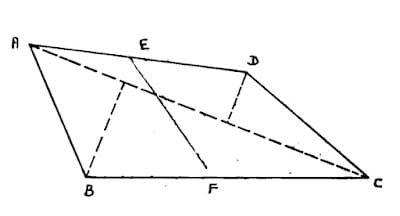
4. Worked example (two parts of a field)
Sketch scale 1:1000, area per small square = 0.25 are.
- Overlay the grid on part ABFE. Suppose whole squares ≈ 43 and part squares ≈ 6 whole-equivalents → total 49 squares.
Area(ABFE) = 49 × 0.25 = 12.25 ares. - Move the grid to part EFCD. Suppose total squares ≈ 53.
Area(EFCD) = 53 × 0.25 = 13.25 ares. - Whole field ≈ 12.25 + 13.25 = 25.50 ares.
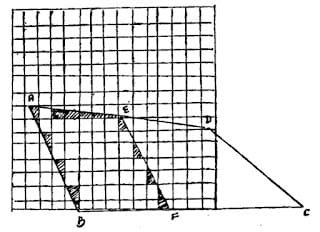
Compare this total with area from chain measurements or coordinates. Large differences mean scale error, bad counting, or a wrong sketch scale.
5. Practical tips
- Work in good light; mark counted squares lightly so you do not double-count.
- For long thin fields, split into two or three overlays (as in the example).
- Never use square paper as the sole basis for mutation extent without confirmation by measurement.
Related tools: Land area calculator · Coordinates area calculator

Corrections & questions
These guides are maintained for practising AP surveyors. If a step is outdated or wrong, tell us — we prioritise field corrections.
Comments are not stored on this page. The report form attaches this URL automatically.