
This is a standard office/field method to cut a required area from an irregular plot (e.g. give 0.60 acre out of a 1-acre holding) when a straight trial line almost works and you only need a small triangular correction. Use links/chains consistently. Recheck with the land area calculator after plotting.
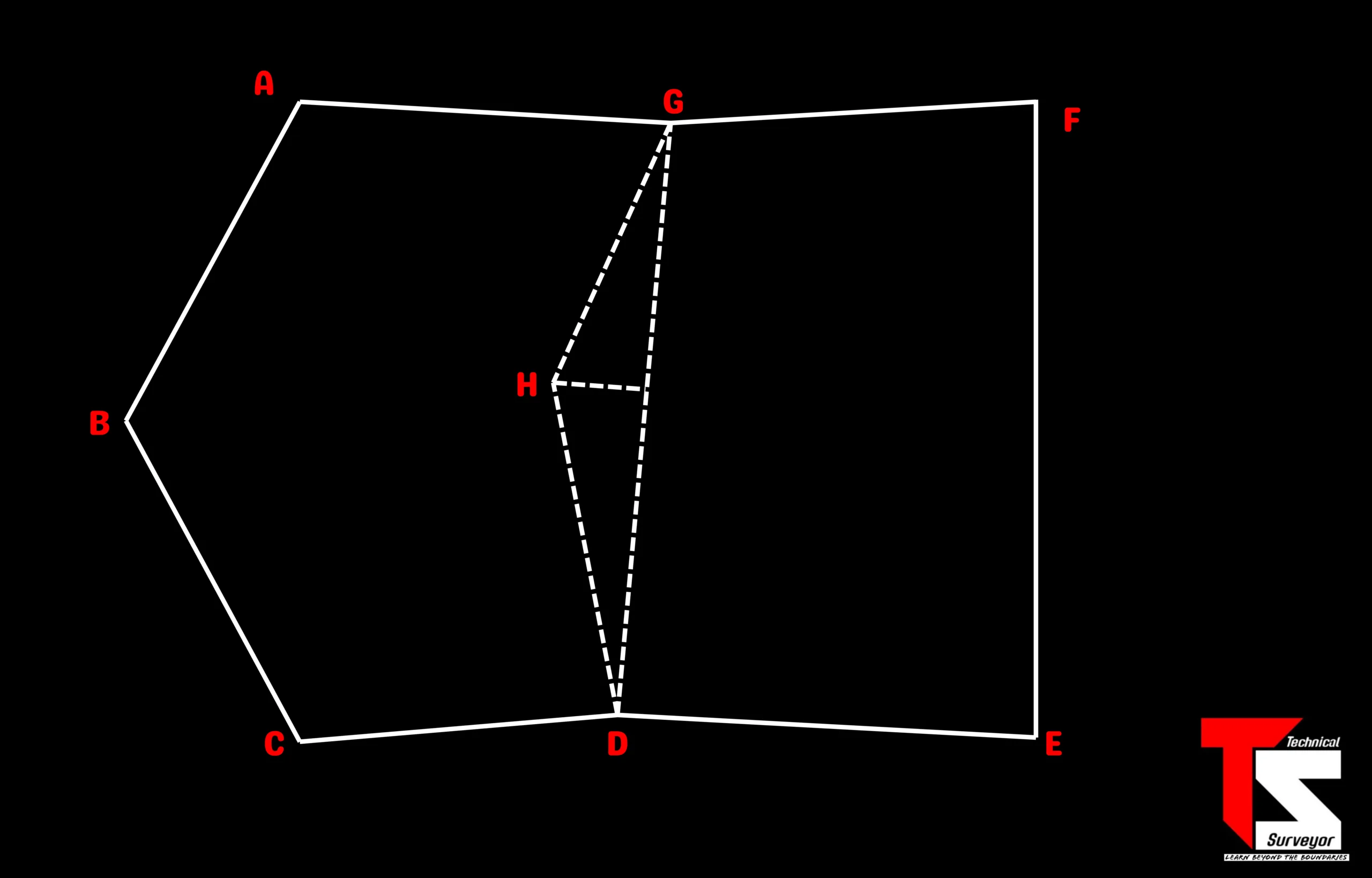
1. Problem setup (worked numbers)
- Whole plot ≈ 1.00 acre.
- Required parcel ≈ 0.60 acre (leave 0.40 acre on the other side).
- All areas in the calculation below use the same unit system (acres ↔ square chains: 1 acre = 10 square chains in the Gunter system used here).
2. Step 1 — Draw a trial partition line
- Pick two convenient points on the boundary, e.g. G and D, and join GD.
- Compute the area of the polygon on one side of GD (example: polygon DEFG).
- In the teaching example, area(DEFG) = 0.50 acre.
- Shortfall to 0.60 acre = 0.10 acre — that extra strip will be taken as a triangle on the other side of GD (or reduced if the trial piece was too large).
3. Step 2 — Convert the correction area
Required extra area = 0.10 acre × 10 = 1.00 square chain.
4. Step 3 — Height of the correction triangle
Measure base GD. Example: GD = 203 links = 2.03 chains.
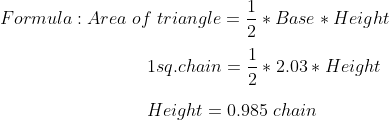
For a triangle: area = ½ × base × height.
So height h = (2 × area) / base = (2 × 1.00) / 2.03 ≈ 0.985 chains ≈ 98.5 links.
That is the perpendicular distance from line GD at which the third vertex H must lie so that triangle GDH has area 1 square chain.
5. Step 4 — Complete the parcel
- From GD, set out perpendicular distance h to fix point H (on the side that adds area if the trial piece was small).
- Join GH and DH. Parcel DEFGH ≈ 0.50 + 0.10 = 0.60 acre.
- If the trial polygon was already larger than the target, build the correction triangle on the opposite side of GD (you are removing area instead of adding).
6. Step 5 — Rectangular cut (simple case)
If both the parent and the cut are rectangles: area = length × breadth. Fix one dimension from the site (road frontage, etc.), solve for the other: breadth = area / length. Convert units with the unit converter before pegging.
7. Field / office checks
- Recompute areas of both final pieces; they must sum to the parent (within allowable error).
- Show H on the sketch with chainage along GD and offset (or two ties).
- Subdivision for mutation still needs proper survey authority, notices, and FMB process — this method only solves the geometry.
Related: Measuring new subdivisions in maintenance · Survey subdivision procedure

Corrections & questions
These guides are maintained for practising AP surveyors. If a step is outdated or wrong, tell us — we prioritise field corrections.
Comments are not stored on this page. The report form attaches this URL automatically.