
Nearest Offset Segment (NOS) is used when a bend stone is missing on the ground but two related points remain, and trial-and-error chaining of both sides would be slow or blocked. You compute where the perpendicular from the missing point meets a known baseline, then the offset length to set the stone.
1. Field situation
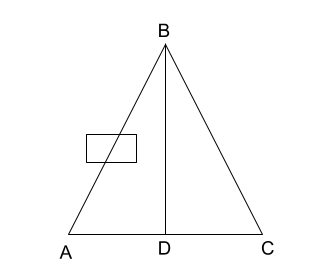
- A and C — intact stones (or recoverable points) on the ground.
- B — missing bend to be re-fixed.
- D — foot of the perpendicular from B to line AC (the cutting point on the baseline).
You need lengths AD (or CD) and BD so you can:
- Chain from A along AC a distance AD to mark D.
- Set a right angle at D and measure offset BD to plant B.
That is faster and more accurate than swinging arcs AB and CB until they meet by trial.
2. Cutting-point distance (AD)
When sides of triangle ABC are known from the FMB (or measured), the cutting distance along AC is given by the standard NOS formula (shown on the teaching plates below):
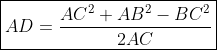
In words: AD is obtained from the three sides of triangle ABC so that D is the foot of the perpendicular from B onto AC. Work carefully with consistent units (links or metres).
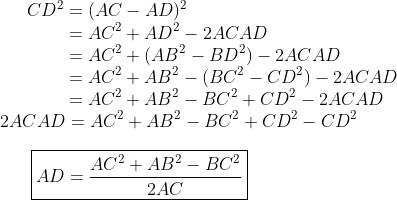
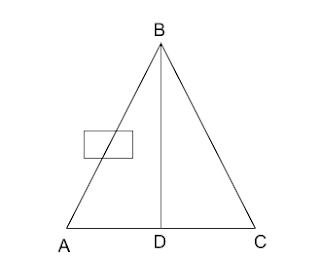
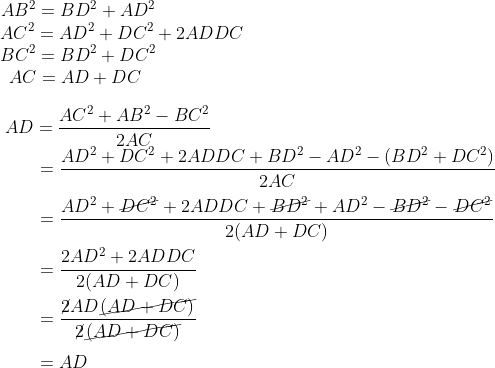
Practical form (when you have sides a = BC, b = AC, c = AB):
AD = (b² + c² − a²) / (2b) — this is the same projection as the cosine rule: AD = c cos∠A when ∠A is at A. Always draw the figure so you know which segment is AD vs CD.
3. Offset distance (BD)
In right triangle BDA (or BDC):
BD = √( AB² − AD² ) or BD = √( CB² − CD² ),
using the side that matches the segment you adopted. You can also get BD from area:
Area(ABC) = ½ × AC × BD ⇒ BD = 2 × Area / AC.


4. Field sequence
- Identify intact points and the missing bend on the FMB.
- Take sides of the triangle from FMB (or remeasure A–C on ground if needed).
- Compute AD and BD; check AD + CD = AC (within rounding).
- Set D on AC; set right angle; measure BD; plant temporary mark at B.
- Verify by measuring AB and CB against FMB (allowable error).
- For a missing stone on a poramboke boundary when G-line trijunctions are intact, measure along the G-line and apply the same chainage + offset logic as per FMB.
5. Common mistakes
- Using AD formula but measuring from the wrong end of AC.
- Offset left/right swapped relative to the FMB orientation.
- Mixing links and metres in one calculation.
Related: UTM area and NOS methodology · FMB bends calculator

Corrections & questions
These guides are maintained for practising AP surveyors. If a step is outdated or wrong, tell us — we prioritise field corrections.
Comments are not stored on this page. The report form attaches this URL automatically.