
Some parcels cannot be chained through the middle: betel gardens, thick shrub, gramakantham clusters, house groups, and similar “isolated” features block lines of sight and access. You still need a correct area and a recoverable boundary. The standard approach is to form a simple envelope (triangle or rectangle) that fully contains the figure, take offsets to every bend, then subtract the outer strips.
1. When to use this method
- You cannot run chain lines safely or accurately through the crop / houses / thicket.
- All boundary bends of the field can be seen from the sides of a larger triangle or rectangle.
- You need plotted area for FMB / subdivision work, not a rough estimate only.
2. Method A — triangle envelope (common for irregular gardens)
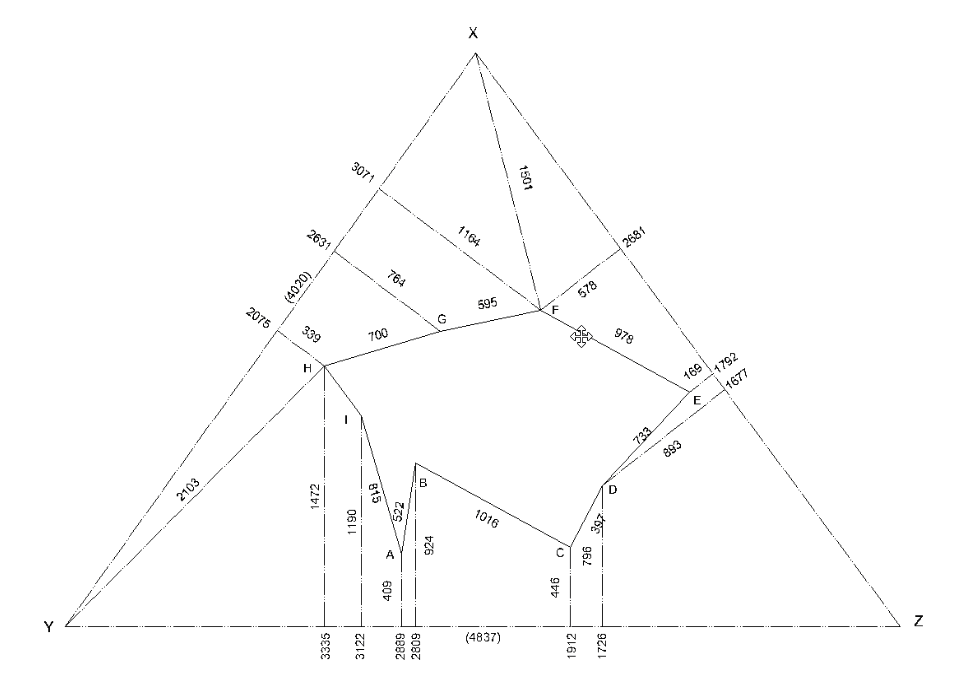
Example: field ABCDEFGH is a betel garden to be surveyed.
- Choose three points X, Y, Z outside the garden so that triangle XYZ contains every bend of ABCDEFGH and each bend is visible from the sides of the triangle.
- Measure the three sides of XYZ carefully (XY, YZ, ZX).
- From each side, take offsets (usually right-angled) to every field bend that falls on that side. Record chainage + offset in the field book for every bend.
- Compute area of triangle XYZ (Heron’s formula or ½ × base × height if you have a height).
- Inside the triangle, the space between XYZ and the garden boundary is made of right triangles and trapeziums formed by the offsets. Compute those areas and subtract them from area(XYZ).
- Result = area of the garden ABCDEFGH.
Heron’s formula (sides a, b, c):
Let s = (a + b + c) / 2.
Area = √[ s(s − a)(s − b)(s − c) ].
3. Method B — rectangle (or square) envelope
- Form a rectangle that fully surrounds the field, with sides free of obstruction if possible.
- Measure length and breadth → area of rectangle = L × B.
- Take offsets from each side to the field bends (same bookkeeping as Method A).
- Subtract the outer right triangles / trapeziums from the rectangle area to get the field area.
Use a rectangle when the parcel is roughly rectangular or when setting right angles is easier than building a large triangle on that ground.
4. Field book discipline
- Sketch the envelope and the field with all bend letters.
- For each offset: side name (e.g. XY), chainage from a named end, offset left/right, target bend letter.
- Do not leave “floating” offsets without a baseline chainage.
- If a bend is not visible from any envelope side, move a station or add a short auxiliary line — never invent a measurement.
5. Check your result
- Recompute one strip area independently.
- Compare with RSR / previous FMB extent if available; large gaps need a reason (encroachment, wrong envelope, missed bend).
- For digital work, replot points and use the land area calculator as a second check.
Related: Diagonal and offset (D&O) system · Area by square paper

Corrections & questions
These guides are maintained for practising AP surveyors. If a step is outdated or wrong, tell us — we prioritise field corrections.
Comments are not stored on this page. The report form attaches this URL automatically.